
Alberta is often introduced through Banff, but the province becomes far more interesting once you stop treating the Rockies as its only story. Calgary is the most practical international gateway, Canmore provides a lively base outside Banff National Park, the Icefields Parkway connects some of the most dramatic mountain scenery in Canada, and the landscape changes completely east of the foothills in Drumheller and the Canadian Badlands. Farther south, Waterton Lakes brings prairie and mountains together in a way that feels different from Banff or Jasper.
For a first trip, I would resist the temptation to drive from one famous name to the next every day. Alberta rewards a route built around distinct landscapes: city, foothills, high mountains and badlands. This guide shows how to combine them realistically, when a rental car matters, where advance reservations are essential and how 2026 access rules affect the most visited national-park areas.
Quick planning overview
| Best gateway | Calgary |
|---|---|
| Ideal first trip | 10–14 days |
| Best for | Mountain scenery, wildlife, road trips, hiking and badlands |
| Car useful? | Yes outside Calgary and some Banff/Canmore transit corridors |
| Peak season | July and August, with strong demand from June through September |
The essential Alberta destinations
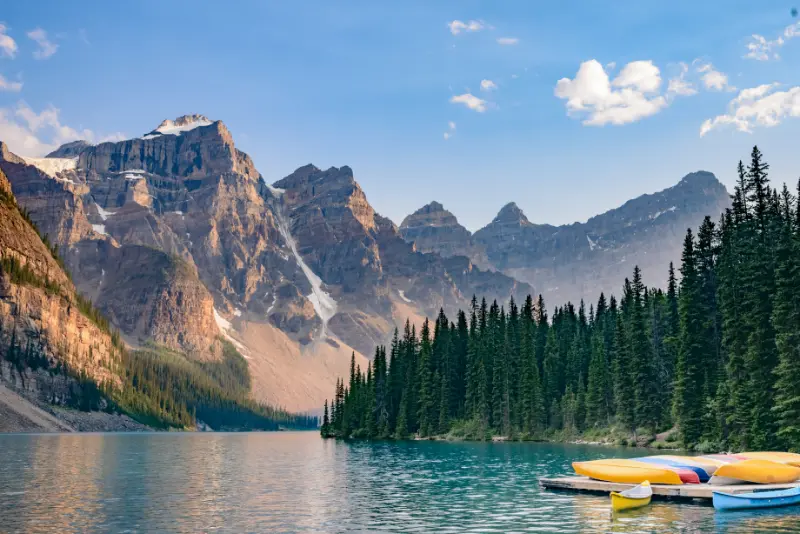
Banff National Park is still the natural anchor for a first Alberta trip. The town of Banff gives you restaurants and transport, Lake Louise and Moraine Lake provide the famous turquoise-water scenery, and the Bow Valley includes drives, hikes and wildlife habitat. However, you should not assume that every attraction is reached by simply driving to a parking lot. Moraine Lake Road remains closed to personal vehicles, and Parks Canada uses a reservation-based shuttle system for the Lake Louise area.
Jasper National Park is larger, more spread out and currently requires more careful planning because recovery from the 2024 wildfire continues. In 2026, Parks Canada reports that virtually all trails have reopened, but Cavell Road and Maligne Canyon remain closed for the season. The town and most of the park are open, which means Jasper still works very well in a Rockies itinerary as long as you use current official maps rather than relying on an older guidebook.
Calgary and Canmore as practical bases
Calgary is more than an airport stop. A full day gives you the river pathways, neighbourhoods, museums and a sense of Alberta before you move into the mountains. It is also the easiest place to collect a rental car, stock up on road-trip supplies and recover from a long-haul flight. Our existing Calgary guide explains how to use the city without sacrificing too much mountain time.
Canmore sits outside Banff National Park and is one of the most useful bases in the region. It has its own mountain atmosphere, good food, trails and access to Kananaskis Country. If you park at provincial park or public-land sites in the Kananaskis Conservation Pass area, a vehicle pass is required; the current Alberta government rate is CAD 15 for a day pass or CAD 90 for an annual personal-vehicle pass.
The Icefields Parkway
The 232-kilometre Icefields Parkway between Lake Louise and Jasper is not just a transfer. It is one of the principal experiences of an Alberta road trip, with glaciers, broad valleys, waterfalls and roadside viewpoints. The pure driving time is only part of the day; once you add Peyto Lake, the Columbia Icefield area, waterfalls and photography stops, the route can easily occupy most of a daylight period.

Fuel and services are limited, cell coverage is unreliable, and mountain weather changes quickly. In winter there are no services along the parkway, and snow tires or chains are mandatory from November 1 to March 31, or whenever the road is covered by snow or ice. Even in summer, carry layers because snow can occur at high elevation at any time of year.
The Canadian Badlands
East of Calgary, the landscape changes from foothills to dry coulees, hoodoos and exposed sedimentary layers. Drumheller is the most convenient base and the Royal Tyrrell Museum is the headline attraction, but the broader value of the region is the contrast with the Rockies. A day or two here prevents an Alberta itinerary from feeling like one continuous mountain postcard.
Dinosaur Provincial Park lies farther southeast and should not be confused with the museum in Drumheller. It is a UNESCO World Heritage Site with guided interpretive programs that can take visitors into protected badlands areas. Because the terrain is fragile and summer heat can be intense, reserve guided experiences in advance and bring more water than you think you will need.
Waterton Lakes and southern Alberta
Waterton Lakes National Park is an excellent extension for travellers with at least ten days. The park is smaller and more compact than Banff, with a townsite, Cameron Lake, Red Rock Canyon, waterfalls and a strong meeting of prairie and mountain landscapes. In 2026 the Akamina Parkway fully opened on May 14 and Red Rock Parkway on May 7; both have seasonal winter restrictions.
Waterton is most naturally combined with southern Alberta rather than squeezed between Banff and Jasper. If you are also crossing into the United States, the Chief Mountain border crossing is seasonal and operates weather permitting, so check official border information instead of assuming it will be open year-round.
How many days do you need?
With one week, focus on Calgary, Banff, Lake Louise and perhaps Canmore. Do not add Jasper unless you are comfortable turning a large part of the trip into driving. Ten days lets you include Jasper via the Icefields Parkway or add Drumheller while keeping a reasonable pace. Two weeks is where Alberta really opens up: Calgary, Banff, Lake Louise, Jasper, Canmore or Kananaskis, plus either the Badlands or Waterton.
If hiking is the main purpose of the trip, reduce the number of regions and add nights in each mountain base. If museums, family attractions and scenic drives matter more, a broader loop can work well because you are less dependent on specific high-elevation trail conditions.
When to visit Alberta
July and August offer the warmest and most predictable access to high mountain trails, but they also bring the highest prices and heaviest demand. June can be beautiful, although snow often remains at elevation. September is one of my favourite planning windows because summer services are still operating in many areas while autumn colour begins at higher elevations, but overnight temperatures can fall quickly.
Winter creates a completely different Alberta. Calgary remains easy to visit, Banff and Canmore become ski and snow-sport bases, and the Icefields Parkway requires serious winter-driving preparation. Shoulder-season travellers should check road, trail and attraction openings carefully because a sunny valley does not guarantee summer-like conditions in the mountains.

National park fees and reservations
National park entry fees apply again from September 8, 2026 after the summer Canada Strong Pass period. A park pass is required when you stop and visit in the national parks, including while travelling scenic parkways such as the Icefields Parkway and Bow Valley Parkway. Camping, shuttles and some activities require separate reservations or fees.
The practical rule is simple: book the hardest logistics first. In Banff, that often means Lake Louise and Moraine Lake transport. In Jasper, confirm what is open. For campgrounds, use Parks Canada reservation dates and avoid building an entire itinerary around a campsite you have not secured.
Practical packing notes
Pack for elevation rather than for the temperature shown in the nearest city. A waterproof shell, insulating layer, sun protection, refillable water bottle and sturdy footwear are useful through most of the mountain travel season. Keep one warm layer and basic rain protection in the day bag instead of leaving everything in the hotel.
On road-trip days, carry snacks, water, a portable battery and offline copies of reservations. Cell service can disappear between mountain communities, so a screenshot of the hotel address or shuttle confirmation is often more useful than assuming you can reload it later.
Wildlife and trail etiquette
Wildlife sightings should slow you down, not pull you closer. Stay inside the vehicle when appropriate, keep the road clear and follow minimum-distance guidance. Never feed animals or leave food unattended at a picnic table. Habituated wildlife can become a danger to people and may ultimately be destroyed.
On trails, stay on the established route even when a shortcut appears obvious. Alpine vegetation and badlands soils recover slowly, and informal paths create erosion. If a closure or wildlife restriction is posted, treat it as part of the trip rather than an obstacle to work around.
Where to stay
Accommodation in Alberta and the Canadian Rockies can become expensive and limited during summer weekends, holidays and major events. I would compare location as carefully as room price, because saving a little on the nightly rate can be cancelled out by parking costs, long transfers or an early-morning drive to a trailhead. Check current accommodation options on Booking.com.
Useful official resources
Banff National Park · Jasper National Park · Kananaskis Conservation Pass
Continue planning your Canada trip
Calgary travel guide · Banff National Park guide · Jasper National Park guide · 10-day Alberta road trip
Final thoughts
The Canadian Rockies are spectacular, but the best trips are not built by collecting as many viewpoints as possible. Leave time for weather, wildlife, traffic, changing trail conditions and places that deserve a slower afternoon. Check official conditions close to departure, use transit where it simplifies the day and treat every mountain drive as part of the experience rather than dead time between attractions.
Disclosure: some links in this article may be affiliate links. If you make a booking through them, Dreaming of Canada may earn a commission at no extra cost to you.
More Alberta city planning
More provincial park inspiration
Explore our Kananaskis Country Guide: Conservation Pass, Hikes, Lakes and 2026 Tips.
More provincial park inspiration
Explore our Writing-on-Stone / Áísínai’pi Provincial Park Guide: Rock Art, Hoodoos and 2026 Tips.
Weekend getaway guides
More regional destination guides
More regional destination guides
More regional destination guides
More regional destination guides
More regional destination guides
More regional destination guides
More regional destination guides
More regional destination guides
More regional destination guides
More regional destination guides
More regional destination guides
More regional destination guides
More regional destination guides
Wetaskiwin · Cold Lake · Lacombe
More Alberta small-town destination guides
More Alberta foothills and mountain-community guides
Sundre · Pincher Creek · Crowsnest Pass
More Alberta mountain-community guides
More southern Alberta destination guides
More local destination guides
More local destination guides
Vegreville Alberta travel guide
More local destination guides
Athabasca Alberta travel guide
More local destination guides
More local destination guides
More local destination guides
Rocky Mountain House Alberta travel guide
More local destination guides
Lac La Biche Alberta travel guide
More local destination guides
More local destination guides
More local destination guides
Bonnyville Alberta Travel Guide
More local destination guides
Wainwright Alberta Travel Guide
More local destination guides
Vermilion Alberta Travel Guide
More local destination guides
More local destination guides
Claresholm Alberta Travel Guide
More local destination guides
More local destination guides
Drayton Valley Alberta Travel Guide
More local destination guides
More local destination guides
Diamond Valley Alberta Travel Guide
More local destination guides
Strathmore Alberta Travel Guide