
British Columbia is one of those destinations that can completely change character within a single travel day. You can start beside the Pacific in Vancouver, drive through fjord-like scenery toward Whistler, cross to Vancouver Island, or continue inland to dry valleys, orchards and mountain passes. That variety is precisely what makes planning a first trip both exciting and slightly complicated.
The biggest mistake is treating the province as if everything were close together. British Columbia is huge, weather can vary sharply by region and many of the most rewarding routes depend on ferries or mountain highways. A better approach is to choose two or three geographic clusters, travel slowly and use Vancouver as a gateway rather than trying to see the entire province in one rushed loop.
Quick planning overview
| Best for | Pacific scenery, mountains, wildlife, road trips and outdoor travel |
|---|---|
| Ideal first trip | 10–14 days |
| Main gateways | Vancouver, Victoria and Kelowna |
| Best road-trip months | Late May to early October, depending on route |
| Car needed? | Very useful outside Vancouver and Victoria |
The best places to visit in British Columbia
For a first visit, I would begin with Vancouver because it combines a genuinely enjoyable city break with immediate access to nature. Stanley Park, the seawall, Granville Island and the North Shore make it possible to alternate urban days with beaches, forest walks and mountain views. Vancouver also connects naturally with the Sea-to-Sky Highway, Vancouver Island and the wider province.
Vancouver Island deserves several days rather than a hurried ferry excursion. Victoria works well for history, gardens and walkable neighbourhoods, while the west coast around Tofino and Ucluelet is about rainforest, broad beaches and Pacific weather. Nanaimo is an important ferry gateway, and the island becomes quieter and more remote as you travel north.
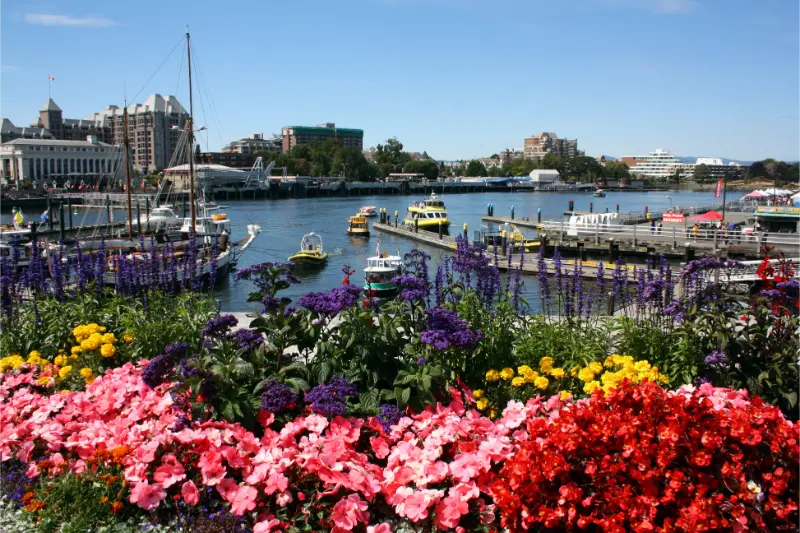
Whistler and the Sea-to-Sky corridor are easy additions from Vancouver. Squamish gives the route a different personality, with hiking, climbing and waterfalls, while Pemberton opens into a more agricultural mountain valley. Farther inland, the Okanagan changes the landscape again with warm summers, lakes, orchards and wine country centred on Kelowna.
How many days do you need?
With one week, concentrate on Vancouver plus one nearby region: either Victoria and southern Vancouver Island, or Whistler and the Sea-to-Sky corridor. With ten days, you can build a satisfying Vancouver–Whistler–Vancouver Island itinerary, although the ferry days need to be planned sensibly. Two weeks allows you to add Tofino or the Okanagan without turning every day into a transfer.
Three weeks gives you the freedom to connect the coast with the interior, but even then I would not try to include every famous place. British Columbia works best when there are half-days without fixed reservations. Those gaps are useful for weather changes, ferry delays, trail closures, unexpected wildlife sightings or simply spending longer in a place that deserves it.
When to visit British Columbia
Summer offers the widest range of road-trip possibilities, long daylight and the easiest access to mountain trails. It is also the busiest and most expensive season in popular places such as Tofino and Whistler. Reservations matter for ferries, campsites and some protected areas. Wildfire smoke can affect parts of the province in some summers, so check regional conditions close to departure rather than assuming the sky will always be clear.
Spring and early autumn can be excellent for Vancouver, Victoria and the coast, with fewer crowds and often better accommodation value. Mountain weather is less predictable and snow can linger on higher trails well into the season. Winter is a completely different trip: Whistler and other mountain areas become ski destinations, while Vancouver and Victoria usually experience milder but wetter conditions than the interior.
Getting around: car, ferries and flights
Vancouver itself is easy to explore without a car, and Victoria can also be handled comfortably on foot and by public transport. Once you start linking smaller communities, provincial parks, beaches and trailheads, a rental car becomes much more useful. Remember that mountain highways can be slower than the distance suggests, and fuel stations are not equally frequent on remote routes.
BC Ferries is part of normal travel in coastal British Columbia, not simply a sightseeing experience. The major Vancouver–Vancouver Island routes are busy, especially on weekends and holidays. If you are taking a vehicle, build the sailing into the itinerary as a fixed travel segment and arrive within the required check-in window. Some routes and fare products have different booking rules, so always verify the exact sailing before you travel.
Building a realistic first itinerary
A strong ten-day first trip could use three nights in Vancouver, two in Whistler or Squamish, two in Victoria and three around Tofino or Ucluelet. This creates a logical coast-and-mountains trip without adding the Okanagan. If wine country matters more than Vancouver Island, keep Vancouver and Whistler, then fly or drive toward Kelowna and spend the final days around Okanagan Lake.
Driving from Vancouver to Kelowna is not a casual city transfer; it is a proper mountain journey whose conditions can change with weather and season. The same is true of continuing from British Columbia into the Canadian Rockies. If Banff and Jasper are part of the same vacation, give them their own block of days rather than trying to treat them as side trips from Vancouver.

Nature, wildlife and responsible travel
British Columbia is bear country, and many routes also pass through habitat used by elk, deer, cougars and other wildlife. Never plan wildlife viewing around approaching animals closely. Keep food secure, follow local instructions and give animals space. In coastal areas, ocean conditions can be equally important: cold water, tides, unexpected waves and changing weather deserve more respect than the apparent calm of a beach on a sunny morning.
Indigenous cultures are fundamental to the province, and many destinations sit within the traditional territories of First Nations. Cultural centres, guided experiences and interpretive sites can add far more depth than simply photographing landscapes. Use official trail and park information, stay on designated routes and treat closures as part of responsible travel rather than an inconvenience to bypass.
Budget and booking strategy
Accommodation is usually the largest variable. Vancouver, Whistler and Tofino can become expensive during peak periods, so booking early can save more than obsessing over small daily expenses. On a road trip, compare the full cost of the car, parking, fuel, ferry fares and one-way charges. Sometimes an itinerary that looks cheaper on a map becomes more expensive once those items are added.
Food costs can be controlled by mixing restaurant meals with markets, bakeries and self-catering. In outdoor destinations, spending more on location can also save time and fuel. A hotel within walking distance of the village or waterfront may be better value overall than a cheaper room that requires repeated drives and paid parking.
Practical packing notes
Pack around conditions rather than the season name. On the coast, a waterproof shell and an insulating layer can be useful even in summer. In the interior, sun protection and drinking water become more important. For hiking, carry enough food and water for delays, not just for the optimistic duration shown on a map.
Keep a small day bag ready with offline reservations, a portable battery, medication and a dry layer. On a road trip, this is much easier than opening the main luggage every time the weather changes.
Travelling more sustainably
Long-distance travel in British Columbia inevitably involves transport, but the itinerary can still be made less wasteful. Stay longer in each base, walk or use transit in Vancouver and Victoria, avoid unnecessary backtracking and choose local operators who explain how they protect the landscapes on which their businesses depend.
Carry a refillable bottle, respect fire restrictions and never leave food or rubbish at viewpoints. Small decisions matter most in heavily visited places where thousands of people may be making the same “small” choice every week.
Weather and flexible planning
Weather is not just a packing question; it should shape the order of activities. Use the clearest forecast for exposed viewpoints, boat trips or major hikes, and keep museums, food experiences or shorter forest walks as flexible alternatives. This makes a trip feel less disappointing when conditions change.
A flexible plan is especially valuable in shoulder seasons. Snow at elevation, heavy coastal rain or smoke in the interior can make two places in the same province feel as if they are experiencing different seasons.
Where to stay
Accommodation can sell out quickly on summer weekends and during major events. I would compare locations as carefully as prices, because a cheaper room can become less attractive if it adds long daily drives or awkward parking. Check accommodation options on Booking.com.
Useful official resources
Destination British Columbia · BC Ferries
Continue planning your Canada trip
Vancouver travel guide · Whistler travel guide · Victoria guide · Canada national parks
Final thoughts
British Columbia rewards travellers who leave room for the journey itself. Distances can look manageable on a map, yet ferries, mountain roads, trail conditions, wildlife, viewpoints and spontaneous stops often become the most memorable part of the day. Build in margin, check current conditions before moving between regions and resist the temptation to turn every day into a race between attractions.
Disclosure: some links in this article may be affiliate links. If you make a booking through them, Dreaming of Canada may earn a commission at no extra cost to you.
Food and culture in British Columbia
Canadian wine regions · Canadian craft beer guide · Indigenous tourism in Canada
More British Columbia city guides
Kelowna travel guide · Nanaimo travel guide
More British Columbia journeys
Pacific Marine Circle Route · Sunshine Coast BC road trip · Vancouver to Victoria ferry · Vancouver to Nanaimo ferry
More island and coastal inspiration
For a more focused escape, see our Salt Spring Island Travel Guide: Ganges, Markets, Farms, Hiking and Ferries.
More island and coastal inspiration
For a more focused escape, see our Haida Gwaii Travel Guide: Haida Culture, Beaches, Gwaii Haanas and Trip Planning.
More island and coastal inspiration
For a more focused escape, see our Pender Island Travel Guide: Hiking, Beaches, Kayaking and Ferry Tips.
More island and coastal inspiration
For a more focused escape, see our Galiano Island Travel Guide: Hiking, Beaches, Food and Ferry Tips.
More provincial park inspiration
Explore our Wells Gray Provincial Park Guide: Waterfalls, Hiking, Lakes and 2026 Tips.
More provincial park inspiration
Explore our Garibaldi Provincial Park Guide: Garibaldi Lake, Elfin Lakes and 2026 Passes.
More provincial park inspiration
Explore our Golden Ears Provincial Park Guide: Alouette Lake, Hiking and 2026 Passes.
More provincial park inspiration
Explore our Mount Robson Provincial Park Guide: Berg Lake Trail, Kinney Lake and 2026 Tips.
More small-town and local destination ideas
Weekend getaway guides
More small-town and local destination ideas
More small-town and local destination ideas
Revelstoke · Tofino · Ucluelet · Osoyoos
More northern and coastal British Columbia destinations
Smithers · Terrace · Prince Rupert · Comox · Harrison Hot Springs
More regional destination guides
More regional destination guides
More regional destination guides
Salmon Arm · Quesnel · Dawson Creek
More regional destination guides
Williams Lake · Powell River · Courtenay
More regional destination guides
More regional destination guides
More regional destination guides
More regional destination guides
More regional destination guides
Kamloops · Campbell River · Prince George
More regional destination guides
100 Mile House · Sidney · Ladysmith · Hope · Mission
More regional destination guides
More regional destination guides
Parksville · Qualicum Beach · Merritt
More regional destination guides
More South and North Okanagan destination guides
More British Columbia local destination guides
Sicamous · Port Hardy · Sechelt · Gibsons
More British Columbia local destination guides
More British Columbia destination guides
Fort Nelson · Wells · Valemount
More Columbia Valley and Kootenay guides
More local destination guides
More local destination guides
More local destination guides
More local destination guides
More local destination guides
More local destination guides
More local destination guides
More local destination guides
Alert Bay British Columbia travel guide
More local destination guides
Vanderhoof British Columbia travel guide
More local destination guides
More local destination guides
Fort St. James BC travel guide
More local destination guides
Radium Hot Springs BC travel guide