
Transport is one of the decisions that can make or break a Canada itinerary. The country is vast, but not every trip requires a car and not every long distance should automatically become a flight. The right choice depends on your region, the season, your luggage, how many people are travelling and whether the journey itself is part of the experience.
The best rule is to plan Canada in transport zones. Toronto, Montréal, Ottawa and Québec City can be linked by rail and city transit. Vancouver is easy without a car for several days. The Canadian Rockies are much more flexible with a vehicle, although local shuttles and transit are increasingly important around Banff and Lake Louise. Coast-to-coast travel is usually a flight unless you deliberately choose a multi-day train journey.
Start with the map—but measure in time, not centimetres
On a world map, Toronto and Vancouver look like two famous Canadian cities that belong to the same trip. In reality, they are separated by thousands of kilometres. A road trip between them is a major journey, not a casual transfer. The same is true of many northern and Atlantic destinations.
Before booking hotels, put every move into a route planner and note the realistic door-to-door time. Add airport transfers, vehicle pickup, fuel stops, mountain traffic and weather. This exercise often improves an itinerary more than adding another attraction.
Flying within Canada
Domestic flights are the practical choice when you are combining distant regions. Toronto–Vancouver, Montréal–Calgary and similar routes save multiple days compared with driving. If your two-week trip includes both eastern cities and the west coast, a flight is usually what makes the itinerary possible.
Do not compare only the flight time. Check baggage rules, airport location, transfer time and the cost of getting to and from the airport. A cheap fare can become less attractive once luggage and ground transport are included.
Train travel: where it makes sense
Rail works best in the densely travelled corridor through Ontario and Québec. VIA Rail connects cities including Toronto, Ottawa, Montréal and Québec City.
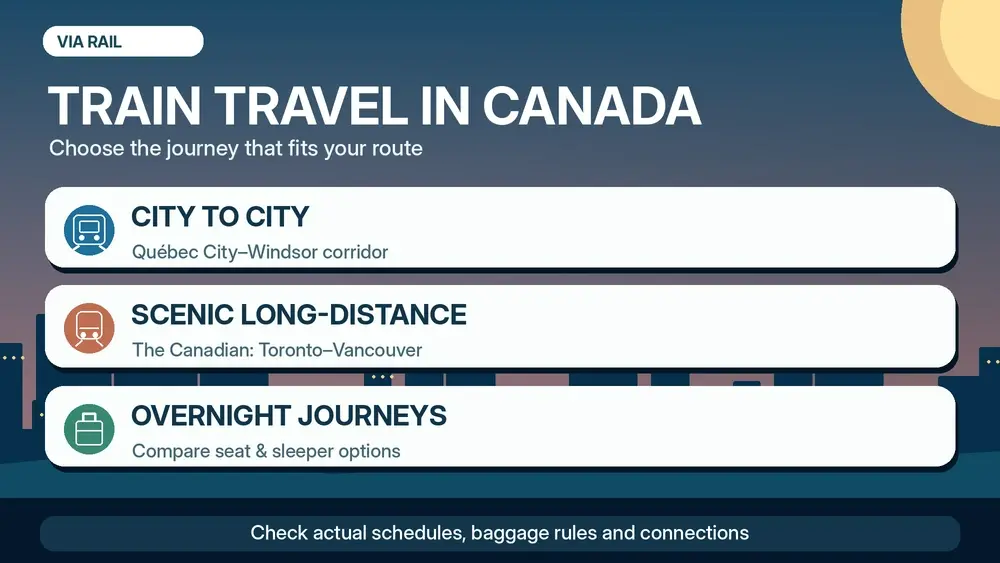
As a current example, VIA Rail lists Toronto to Montréal at an average journey of roughly 5 hours 13 minutes, with multiple weekly departures. Exact schedules change, so use the official VIA Rail website for your dates.
For a first eastern Canada trip, rail can remove the need for a rental car. You can arrive in Toronto, visit Niagara Falls as a day trip or overnight, continue to Montréal and then Québec City. That route is described in our two-week itinerary guide.
The Canadian: train as an experience, not just transport
VIA Rail’s long-distance services, including the route between Toronto and Vancouver, are different from an ordinary intercity transfer. They are multi-day journeys and should be treated as a central travel experience. If you only have two weeks in Canada and your priority is destinations rather than rail travel, flying will usually give you much more time on the ground.
If a scenic long-distance train is part of your dream, build the itinerary around it instead of squeezing it between cities.
Rental cars: when they are worth it
A car becomes valuable when the places you want to visit are spread across rural areas, national parks or scenic roads. The Rockies are the clearest example. A car gives you flexibility for viewpoints, trailheads and stops along the Icefields Parkway, though some high-demand destinations require shuttles or restrict private vehicles.

A car can also be useful for countryside trips in Québec, Ontario wine regions, Atlantic Canada and less-connected areas of British Columbia. In downtown Toronto, Montréal or Vancouver, however, you may pay for parking while barely using the vehicle.
One-way rentals and drop fees
A one-way road trip can save time, but rental companies may charge a drop fee depending on route, season and vehicle. Always compare the total cost of a one-way rental with a round-trip rental plus a flight or train. If you plan to cross provincial lines, confirm that your rental agreement allows the route.
Driving in the Canadian Rockies
The Icefields Parkway between Lake Louise and Jasper is one of Canada’s most memorable drives, but it is not a normal urban highway. Mobile coverage is limited, services are spaced apart and weather changes quickly. Fill your tank, carry water and snacks, download offline maps and check official road conditions.
Wildlife on or near the road is another reason to drive conservatively. Stopping suddenly for a photograph can create dangerous situations. Use designated pullouts where possible and never approach animals.
Our Banff and Jasper road-trip guide includes a realistic route and details on Lake Louise and Moraine Lake access.
Moraine Lake and Lake Louise: why “having a car” is not enough
Personal vehicles are not permitted on Moraine Lake Road. Parks Canada directs visitors to shuttles, public transit or licensed commercial services. Parks Canada releases shuttle reservations according to the published seasonal booking calendar, with a portion of seats offered in advance and more released on a rolling basis shortly before travel dates.
This is a good example of modern Canadian trip planning: some famous natural areas are easier if you plan transport before accommodation rather than assuming you can simply drive to the door.
City public transport: Toronto
Toronto has a large public transport network of subway, streetcars and buses, operated by the TTC, plus regional GO Transit. Visitors staying centrally can explore most major areas without a car.
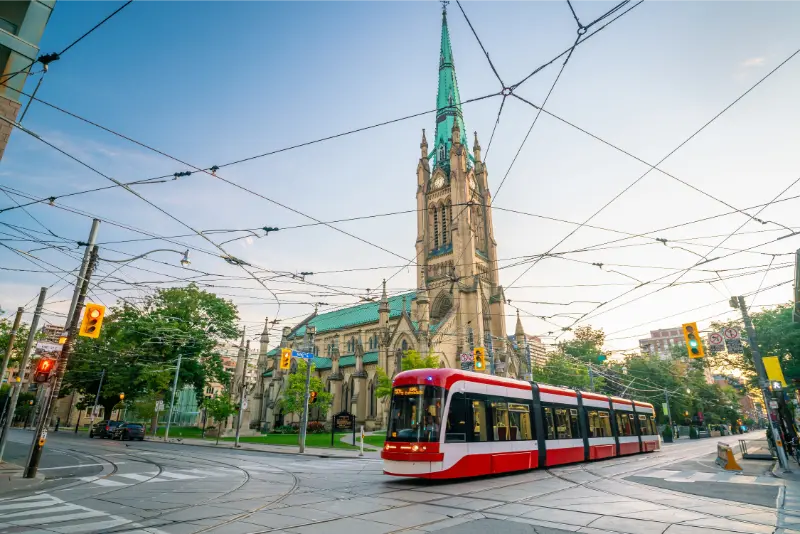
The airport is connected to downtown by the UP Express train to Union Station, while taxis, ride-hailing and other options are also available.
For sightseeing, location matters. Staying near a subway station or within walking distance of downtown attractions can eliminate many taxi rides. See our Toronto travel guide for neighbourhood suggestions.
City public transport: Montréal
Montréal is one of the easiest Canadian cities to explore without a car. The métro and bus network is useful, while central districts such as Old Montréal, Downtown, Plateau and Mile End reward walking. Cycling can also be excellent in good weather.
Parking and one-way streets can make a rental car more trouble than it is worth for a short urban stay. If Montréal is part of a longer driving holiday, consider picking up the car when you leave the city rather than paying to store it while you sightsee.
City public transport: Vancouver
Vancouver combines SkyTrain, buses and SeaBus, and many visitor areas are walkable. The Canada Line connects Vancouver International Airport with the city. For a few days focused on Downtown, Stanley Park, Granville Island and nearby neighbourhoods, a car is optional.
Rent a car only for the days you genuinely need it—for example, for certain day trips or the start of a longer British Columbia road trip. Our Vancouver guide explains how to structure a car-free city stay.
Buses and coaches
Intercity buses fill gaps where rail is unavailable and can be useful for airport connections, ski towns and short regional routes. Operators vary by province and corridor, so there is no single national bus system to rely on. Compare the departure station, luggage rules and actual travel time before booking.
Ferries: essential in parts of British Columbia and Atlantic Canada
Ferries are not just tourist cruises. In British Columbia, ferry services connect the mainland with Vancouver Island and other coastal communities. If your itinerary includes Victoria, the ferry is part of the transport plan unless you fly. Vehicle reservations can matter during busy periods.
Winter driving
Winter changes the calculation. Snow, black ice, reduced visibility and road closures can turn a simple route into a serious drive. Winter-tire rules vary by province and road. If you are not comfortable with winter conditions, using trains, flights and organized transfers may be a better choice.
For mountain routes, never assume conditions in a city describe conditions at elevation. Check road reports shortly before departure and leave room to change plans.
Should you rent a car for a first trip?
For Toronto–Montréal–Québec City: usually not for the whole trip. Use public transport and trains, then rent only for a specific countryside extension if needed.
For Vancouver only: usually not. For Vancouver plus Whistler, it depends on your plans because buses and tours also operate. For Banff and Jasper: a car gives excellent flexibility, but local transit and shuttles remain important.
Transport and families
Families should compare convenience, not just ticket price. Four train or plane tickets can make a rental car look attractive, but child seats, parking, fuel and one-way fees add cost. In city centres, not having to install seats repeatedly can make public transport much easier.
Transport and luggage
Every extra suitcase becomes part of the route. Rail and road trips can be easier with luggage than low-cost flights, while downtown hotels may charge for parking. If you move every one or two nights, packing light has a direct impact on how enjoyable the trip feels.
My recommended combinations
- Toronto + Montréal + Québec City: train and city transit.
- Toronto + Niagara Falls: organized day trip, regional transport or rental car depending on your schedule.
- Vancouver city: public transport and walking.
- Banff + Jasper: rental car plus shuttles/transit for restricted or congested areas.
- Eastern Canada + Vancouver/Rockies: domestic flight between regions.
Before you book any transport
Check cancellation rules, luggage, parking, seasonal road access and the last connection of the day. Then add a buffer. Canada is a destination where a little extra time often buys a much calmer trip.
Use our first-time Canada travel guide as the starting point, then choose a route from the two-week itineraries before committing to flights, trains or a rental car.
Disclosure: some links in this article may be affiliate links. If you make a booking through them, Dreaming of Canada may earn a commission at no extra cost to you.
Major Canada airport guides
YYC Calgary · YYJ Victoria
Canada city-to-city transport guides
Toronto to Montréal · Toronto to Ottawa · Montréal to Québec City · Vancouver to Whistler · Calgary to Banff · Edmonton to Jasper · Vancouver to Kelowna ·
Airport transfer guides for Canadian cities
Calgary · Winnipeg